Thermal putty is a thermal interface material (TIM) used to fill the gap between a heatsink and heat-generating components. It is a soft, moldable, and compressible material with a clay-like texture. Thermal putty is also sticky, which helps it adhere to surfaces and remain in place during installation. However, the consistency and stickiness vary between brands and products.
Thermal putty is an alternative to thermal pads and can be used in many applications where thermal pads are used. It fills the gaps between the heatsink and components such as VRAM, VRM, MOSFETs, inductors, chipsets, and ICs. Unlike thermal pads, which come in fixed thicknesses, thermal putty conforms to different component heights and irregular gaps, making it particularly useful in graphics cards, laptops, gaming consoles, and other electronic devices.
Choosing thermal putty can be difficult because there are fewer well-known brands available than thermal pads, and many users have little experience applying it. Thermal conductivity, consistency, compressibility, ease of application, and the gap that needs to be filled are all important factors when choosing the right thermal putty.
Thermal Putty Thermal Conductivity
Thermal conductivity depends on the composition and formulation of the thermal putty. Some thermal putties offer average thermal conductivity, while others are designed for higher heat transfer performance. The thermal conductivity of thermal putty can range from around 6 W/mK to over 18 W/mK, depending on the product.
However, a higher thermal conductivity rating does not always guarantee better cooling. The thickness of the thermal putty layer, its compressibility, contact area, and the mounting pressure of the heatsink also affect thermal performance. A thermal putty that fills the gap properly and maintains good contact with both surfaces may perform better than a higher-rated product that is too hard or poorly compressed for the application.
Thermal Putty Bond Line Thickness (BLT)
Thermal Putty Bond Line Thickness (BLT) refers to the thickness of the thermal putty layer between two surfaces. Thermal putty can generally achieve a minimum bond line thickness of around 0.1 to 0.2 mm, depending on its composition and compressibility.
A lower bond line thickness generally reduces thermal resistance and improves heat transfer. However, the final thickness depends on the original gap between the heatsink and the component, the amount of thermal putty applied, and the mounting pressure exerted by the heatsink. Thermal putty should fill the gap without preventing the cooler from sitting properly.
Thermal Putty vs Thermal Pad
Thermal putty and thermal pads are both used as gap fillers between heat-generating components and heatsinks. However, they differ in their consistency, compressibility, application process, and suitability for different gaps.
Thermal Putty vs Thermal Pad Comparison
| Thermal Putty | Thermal Pad | |
| Texture | Soft, clay-like, and sticky | Solid with a soft-touch feel |
| Compressibility | Highly compressible | Less compressible |
| Thermal Conductivity | Depends on the composition/formulation | Depends on the composition/formulation |
| Electrical Conductivity | Not electrically conductive | Not electrically conductive |
| Operating Temperature | Wide range | Wide range |
| Reusable | Mostly not | Yes |
| Applications | VRM, VRAM, chipset, IC | VRM, VRAM, chipset, IC |
Thermal Putty Advantages
Thermal putty maintains consistent gap filling across components of different heights. It is relatively easy to apply because it can be shaped according to the contact area and gap size. It is also highly compressible and spreads well under relatively low mounting pressure, making it suitable for irregular gaps where using thermal pads of different thicknesses can be difficult. Thermal putty is particularly useful when the components are not at the same height or when the gap between the PCB and heatsink varies across the contact area.
Thermal Putty Disadvantages
Thermal putty is generally not reusable once applied. If the heatsink is removed, the thermal putty usually needs to be cleaned and reapplied. It can also create a sticky mess around the components and PCB, making removal more difficult. Some putties leave residue and may require considerable cleaning with isopropyl alcohol (IPA). There are also fewer thermal putty options available compared to thermal pads, making it more difficult to choose a product with the right consistency and thermal performance.
Thermal Pad Advantages and Disadvantages
Thermal pads are reusable and generally easier to remove without creating a sticky mess. However, thermal pad application requires more experience because the correct thickness must be selected for the gap. Using a pad that is too thick or too thin can result in poor contact between the heatsink and the components, leading to higher temperatures. Thicker thermal pads may also exert excessive mounting pressure, potentially damaging components, deforming circuit boards, or affecting the clearance of other parts of the cooling assembly.
Thermal Putty vs Thermal Pad Cooling Performance
The cooling performance of thermal putty and thermal pads depends mainly on their formulation, thermal conductivity, thickness, compressibility, and contact quality. If thermal putty and a thermal pad have similar thermal conductivity, thermal putty may achieve lower temperatures in some applications. This is because thermal putty can conform more closely to irregular surfaces and different component heights, providing more uniform contact between the heatsink and the heat-generating components. However, thermal putty does not always outperform thermal pads. The result depends on the application, the size of the gap, the thermal interface material used, and the mounting pressure.
Thermal Putty Applications and Colors
Thermal putty is primarily used to fill gaps between heatsinks and components such as VRAM, VRM, MOSFETs, inductors, chipsets, and ICs. It is suitable for graphics cards, laptops, desktop PCs, consoles, and other electronics where gap filling is required. Thermal putty is available in different colors depending on the manufacturer, composition, and dye used. Common colors include pink, blue, brown, white, grey, and their lighter or darker variations.
How to Apply Thermal Putty?
Clean the contact surfaces and apply thermal putty only to areas where the gap between the component and cooler needs to be filled. Use a clean spatula or gloves to shape the putty into appropriately sized portions. The amount required depends on the contact area and gap thickness. A little excess putty may spread out to the sides during installation, as long as there is sufficient clearance.
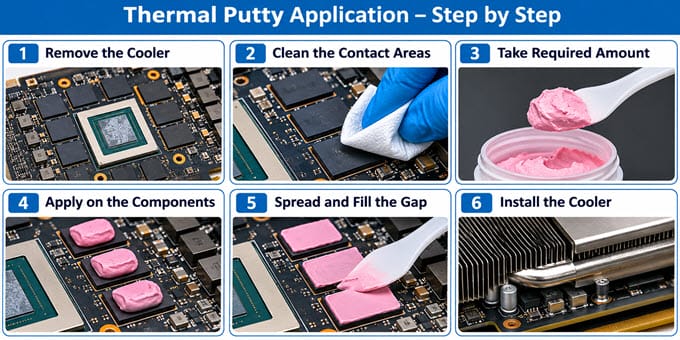
Install the cooler using the same mounting pressure as you would when using thermal pads. The putty should make full contact with both surfaces without preventing the cooler from sitting properly on the GPU or other main chip. For the GPU or CPU die itself, use a suitable thermal paste or other thin thermal interface material designed for direct chip contact.
How Much Thermal Putty Is Required?
The quantity of thermal putty required depends on the component area, the gap thickness, and the number of components that need to be covered. Generally, 30 g to 50 g of thermal putty should be sufficient for most laptop, GPU, and console applications, although larger graphics cards, backplates, and larger gaps may require more.
Avoid applying too much putty, as excess material may spread around the components during cooler installation. Make sure there is sufficient clearance around the components and that the cooler can sit properly after installation.
Where to Use Thermal Putty
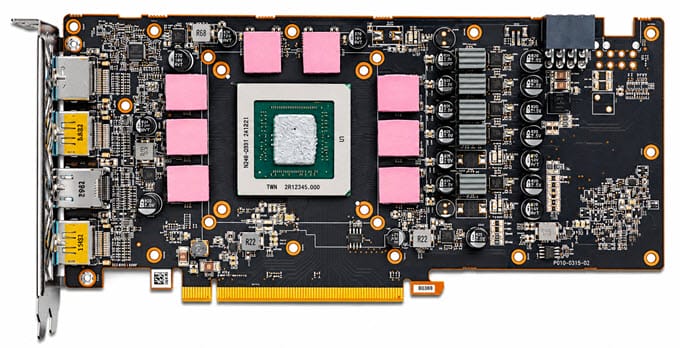
Thermal putty can be used on VRM, VRAM, motherboard chipset, MOSFETs, inductors, and other ICs in desktop PCs, laptops, graphics cards, and consoles such as the PS5, provided the application requires a gap-filling thermal interface. Thermal putty can also be used on the SSD controller and NAND memory of NVMe SSDs. In the image below, you can see pink thermal putty being used on a graphics card’s VRAM or video memory chips.
Where Not to Use Thermal Putty
Thermal putty should not be used as a replacement for thermal paste on the CPU or GPU die. These surfaces require a thin thermal interface layer to maintain proper contact with the heatsink. Thermal putty is designed to fill gaps and is generally too thick to be used as a direct-die thermal interface material.
For the CPU and GPU die, use thermal paste or a suitable phase-change thermal interface material designed for direct contact. Thermal putty should be used for surrounding components where larger gaps need to be filled.
Best Thermal Putty for VRAM, VRM, Chipset, IC
The following thermal putties are worth considering for VRAM, VRM, chipset, MOSFETs, and other gap-filling applications. Their specifications and consistency vary, so choosing one based on the application is important rather than simply looking at the advertised thermal conductivity.
Thermal Grizzly TG Putty
[Premium Quality, Three Variants, Easy to Apply]
Thermal Grizzly is a well-known brand in the PC cooling market, particularly for thermal pastes, thermal pads, and other thermal interface materials. Its TG Putty series is designed to replace traditional thermal pads in applications where different component heights and varying gaps make conventional thermal pads difficult to use.
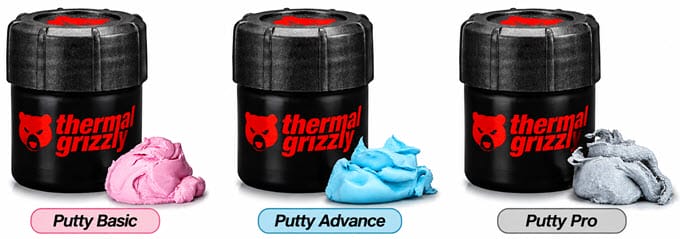
TG Putty is available in three variants: Basic, Advance, and Pro. These variants are primarily differentiated by their thermal conductivity, with Basic offering medium thermal conductivity, Advance offering good thermal conductivity, and Pro offering very good thermal conductivity.
The putty is electrically non-conductive and can fill gaps from approximately 0.2 mm to 3.0 mm. It can be shaped using spatulas or manually with gloves. It is suitable for GPU VRAM, VRM, laptops, gaming consoles, handheld devices, and other compatible electronics.
Thermal Grizzly TG Putty variants
- TG Putty Basic: Designed for applications requiring medium thermal conductivity. It is the more affordable option in the series.
- TG Putty Advance: Offers good thermal conductivity and is a balanced option for GPU memory and voltage regulators.
- TG Putty Pro: Offers very good thermal conductivity and is intended for users looking for the best thermal performance.
The TG Putty series is a good choice for replacing thermal pads on graphics cards, particularly when multiple pad thicknesses are used in the original cooler. The Advance variant is a good middle-ground option, while Basic suits budget-conscious applications and Pro is for users prioritizing thermal performance.
| Thermal Grizzly TG Putty Specifications | |
| Thermal Conductivity | Basic: Medium; Advance: Good; Pro: Very good |
| Operating Temperature | -40°C to +120°C |
| Color | Basic: Pink; Advance: Blue; Pro: Grey |
| Quantity Available | 30 g and 100 g |
UPSIREN UTP-8 Thermal Putty
[Most Popular, Best Allrounder, High Thermal Conductivity]
UPSIREN is a Chinese brand specializing in thermal interface materials and PC cooling products. Its product range includes thermal putty, thermal pads, thermal paste, cooling fans, CPU coolers, and liquid cooling products. The UPSIREN UTP-8 is one of its popular thermal putties and is designed as an alternative to conventional thermal pads. It is suitable for filling gaps between heatsinks and components such as VRAM, VRM, MOSFETs, and other ICs. It is soft, compressible, and designed to conform to uneven surfaces, making it useful for graphics cards, laptops, and other electronic devices.
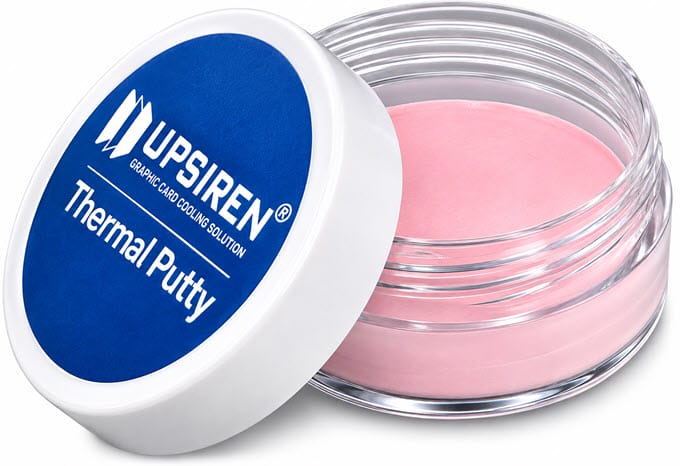
UTP-8 has a thermal conductivity of 14.8 W/mK. It is electrically non-conductive and is available in multiple quantities. It can be used to replace thermal pads in applications where the component heights or gaps are not uniform. UTP-8 is a good all-round thermal putty for GPU VRAM and VRM replacement applications. It offers a relatively high thermal conductivity, and its compressible consistency makes it suitable for filling gaps between components of different heights. It is also available in multiple quantities, allowing users to buy only what is required for a repair.
| UPSIREN UTP-8 Thermal Putty Specifications | |
| Thermal Conductivity | 14.8 W/mK |
| Operating Temperature | -55°C to +200°C |
| Color | Pink |
| Quantity Available | 10 g, 20 g, 50 g and 100 g |
Buy UPSIREN UTP-8 Thermal Putty
Other UPSIREN Thermal Putties
UPSIREN has a good range of thermal putties. Here are the other UPSIREN thermal putties that you can consider.
| UPSIREN Thermal Putty | Thermal Conductivity | Consistency / Characteristics | Best Suited For |
| UPSIREN U6 | 12.8 W/m·K | General-purpose thermal putty | VRAM, VRM, ICs |
| UPSIREN UX Pro Ultra | 16.8 W/m·K | Dry, hard, less compressible | Larger gaps, VRM |
| UPSIREN UTP-8 | 14.8 W/m·K | Soft, workable, good compressibility | VRAM, VRM, thermal pad replacement |
| UPSIREN UTP-4 | 10.8 W/m·K | Ultra-Thin | Gap-filling applications, Laptops |
| UPSIREN UTP-6 | 12.8 W/m·K | Low-viscosity, tacky, compressible | Memory, heatsinks, electronic components |
| UPSIREN UTP-X | 16.8 W/m·K | Thermally conductive Silicone and Aluminum Nitride composition | VRAM, VRM, IC etc. |
| UPSIREN DTP-XII | 18.8 W/m·K | Polycrystalline Diamond composition, easy to clean and apply | VRAM, VRM, IC etc. |
PolarTronix Thermal Putty
[Made in USA, 14.8 W/mK, Wide Applications]
PolarTronix is a thermal management brand that offers thermal putty designed to fill variable gaps between heat-generating components and cooling hardware. Its thermal putty is manufactured in the USA and is intended for applications where component heights and clearances vary, making traditional thermal pads less practical.
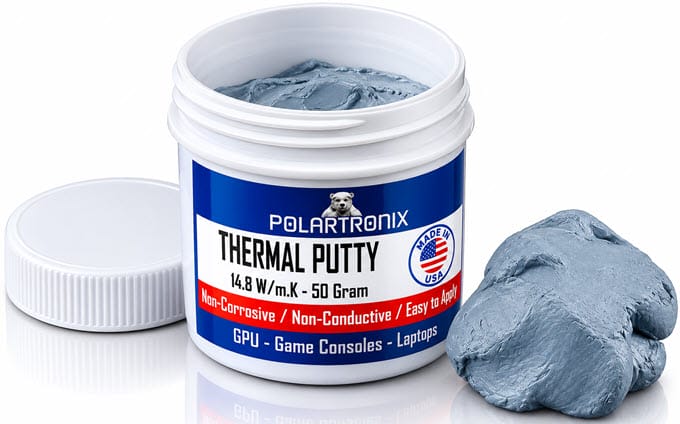
PolarTronix Thermal Putty has a thermal conductivity of 14.8 W/mK. It is a soft, moldable, and compressible gap-filling material intended for VRAM, VRM, MOSFETs, inductors, coils, and other compatible components. It can be used in graphics cards, laptops, PS5, Xbox Series X, compact PCs, and other electronics.
The putty is electrically non-conductive and comes in a 50-gram jar, making it suitable for multiple thermal pad replacement or repair applications. PolarTronix Thermal Putty is a good option for users who need a high-conductivity gap filler for different component heights. The 50-gram quantity is suitable for multiple applications, and its moldable consistency allows it to conform to irregular gaps between components and heatsinks.
| PolarTronix Thermal Putty Specifications | |
| Thermal Conductivity | 14.8 W/mK |
| Operating Temperature | Not specified |
| Color | Grey |
| Quantity Available | 50 g |
Other Thermal Putties
Here are a few more thermal putties and putty-type products to consider.
GSCOLER GTP-1 Thermal Putty
GSCOLER GTP-1 is a non-conductive thermal putty that is rated at above 15 W/mK, which makes it one of the higher-rated putties around. It is sold as a thermal paste and thermal pad alternative for GPU VRAM, VGA units, IC chips, consoles, and servers, and it is available in small 10 g, 20 g, and 30 g packs, which is enough for a single GPU or a laptop.
Arctic PX-1 Thermal Putty Pad
Arctic PX-1 is a hybrid of thermal putty and thermal pad, as it has the properties of both. It is way more compressible compared to thermal pads, and it is not messy and unmanageable like thermal putty. It is shaped in a thick sheet like a thermal pad and can be easily cut into various sizes like thermal pads. The material is soft and clay-like, easy to shape and trim, and it is 1.5 mm (0.06 in) thick, which is ideal for GPU VRAM, VRM arrays, MOSFETs, and chokes. Arctic does not publish the thermal conductivity of the PX-1.
MoneyQiu MYU168 Thermal Putty
MoneyQiu MYU168 is a 16.8 W/mK thermal putty sold in a 50 g pack. It has one of the highest claimed thermal conductivity values in this list, so it is worth a look if you need more putty for a large area like a graphics card with many memory chips.
Final Words
Thermal putty is a useful alternative to thermal pads for filling gaps between components and heatsinks. Its moldable and compressible nature makes it particularly useful when components are positioned at different heights or when the gap varies across the contact area. It can help achieve more uniform contact without having to use several thermal pads of different thicknesses.
If thermal pads are not working well for you in getting temperatures down, thermal putty is worth trying. However, choosing the correct material and applying the right amount are important for getting good cooling performance. If you have any questions, let me know in the comments below.
(*This post may contain affiliate links, which means I may receive a small commission if you choose to purchase through the links I provide (at no extra cost to you). Thank you for supporting the work I put into this site!)