Vapor Chamber is an advanced cooling solution that operates on the principle of phase-change cooling. It is commonly used in high-end graphics cards with higher power consumption and thermal output, where conventional cooling solutions may struggle to dissipate heat efficiently. A vapor chamber is essentially a sealed, flat metal chamber containing a small amount of working fluid, usually water. It helps spread heat over a larger surface area, allowing the cooler to transfer heat more efficiently to the heatsink.
Most graphics cards with vapor chamber cooling use it as a base plate that makes direct contact with the GPU and memory chips. However, some models, particularly blower-style graphics cards, use an extended vapor chamber that also covers the VRM components. Vapor chamber cooling is found in graphics cards from several manufacturers, including ASUS, MSI, Gigabyte, Palit, Gainward, GALAX, INNO3D, Sapphire, XFX, PowerColor, and ASRock. NVIDIA also uses vapor chamber cooling in its Founders Edition graphics cards.
In this article, we explain how vapor chamber cooling works, its advantages over conventional cooling solutions, and list NVIDIA and AMD graphics cards that feature vapor chamber cooling.
How Vapor Chamber Cooling Works
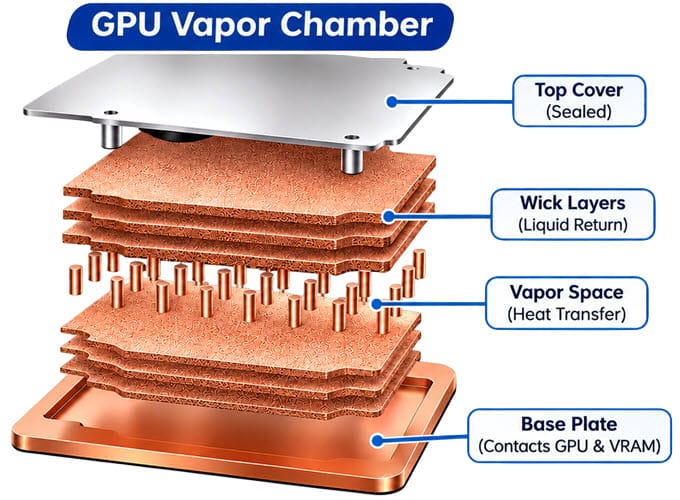
A vapor chamber consists of a sealed metal enclosure containing a working fluid and an internal wick structure. The chamber is usually made of copper and operates under a partial vacuum, allowing the working fluid to evaporate at a relatively low temperature. The working principle of a vapor chamber is similar to that of a heat pipe. However, unlike a conventional heat pipe, which transfers heat primarily along its length, a vapor chamber spreads heat in two dimensions across a relatively flat surface.
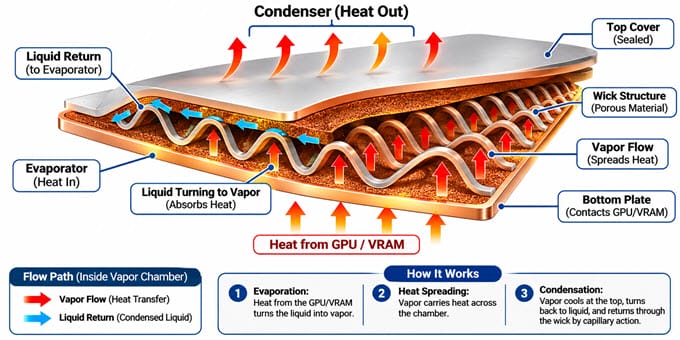
When the GPU heats up, heat is transferred to the vapor chamber through direct contact. The working fluid near the heat source absorbs this heat and evaporates into vapor. The vapor then moves towards cooler areas inside the chamber, where it releases heat and condenses back into liquid. The internal wick structure uses capillary action to transport the liquid back towards the heat source, and the cycle repeats. This continuous evaporation and condensation process allows the vapor chamber to distribute heat quickly and evenly across its surface. In a graphics card, the vapor chamber transfers heat from the GPU and memory chips to the main heatsink. The heatsink, which consists of aluminum fins and copper heat pipes, dissipates the heat into the surrounding air with the help of cooling fans.
Vapor Chamber vs Solid Copper Base Plate
A solid copper base plate is a conventional cooling solution used in many graphics cards. It makes direct contact with the GPU and transfers heat to the heatsink through conduction. Copper has excellent thermal conductivity, making it suitable for transferring heat away from the GPU. However, a solid copper plate mainly spreads heat through its metal structure, and its heat distribution depends on the plate’s thickness, size, and design.
A vapor chamber uses a phase-change mechanism to distribute heat across its surface. Instead of relying only on the thermal conductivity of copper, it uses evaporation and condensation to transfer heat from hotter areas to cooler areas. This makes vapor chambers particularly useful for high-power GPUs that generate concentrated heat.
Advantages of Vapor Chamber over Solid Copper Base Plate
- Better heat spreading: A vapor chamber distributes heat more evenly across its surface, reducing localized hot spots.
- Faster heat transfer: The phase-change mechanism allows heat to spread efficiently from the GPU contact area to a larger surface.
- Improved thermal performance: It can offer better cooling performance than a conventional solid copper plate, particularly with high thermal loads.
- More efficient cooler design: Vapor chambers can spread heat effectively without requiring an excessively thick copper base plate.
However, a vapor chamber is not automatically better than every solid copper base plate. Its performance depends on the internal wick structure, chamber dimensions, working fluid, manufacturing quality, and overall heatsink design.
Vapor Chamber vs Heat Pipes
Heat pipes and vapor chambers both use phase-change cooling to transfer heat. However, their physical construction and heat-transfer characteristics are different. A conventional heat pipe is a sealed metal tube containing a working fluid and an internal wick structure. It transfers heat from one end to another through evaporation and condensation.
A vapor chamber uses the same principle but has a flat, enclosed structure that spreads heat across a larger two-dimensional surface. In graphics cards, heat pipes are generally used to transfer heat from the GPU cooler’s base to different sections of the heatsink. A vapor chamber, on the other hand, is commonly used as a base plate that spreads heat from the GPU and memory chips before transferring it to the heatsink.
Advantages of Vapor Chamber over Heat Pipes
- Better heat distribution: A vapor chamber spreads heat across a wider surface instead of primarily transferring it along a tube.
- More uniform temperatures: It helps reduce temperature differences between different areas of the cooling plate.
- Effective for high-power GPUs: It is particularly useful for GPUs with high thermal output and concentrated heat generation.
- Larger contact area: Its flat construction allows it to cover the GPU and memory chips simultaneously.
Heat pipes are generally more flexible in cooler design and relatively inexpensive to manufacture. They can also be used alongside a vapor chamber to further improve heat transfer. For this reason, many high-end graphics cards use a combination of vapor chambers and heat pipes rather than relying on either technology alone.
Types of Vapor Chamber Designs
Vapor chambers used in graphics cards can have different physical constructions and configurations. Their thickness, size, internal wick structure, and coverage area can vary depending on the cooling requirements. Below are the main vapor chamber types and designs used in GPU cooling.
Standard Vapor Chamber (2D)
A standard or 2D vapor chamber is a flat, sealed chamber that spreads heat across its surface. It is generally used as a base plate in graphics card coolers. The chamber makes direct contact with the GPU and sometimes the surrounding memory chips. It then transfers heat to the main heatsink through conduction. The size of the vapor chamber can vary depending on the graphics card’s cooling requirements. Some models use a compact chamber that covers only the GPU, while others use a larger chamber that also covers the VRAM.
Hybrid Vapor Chamber
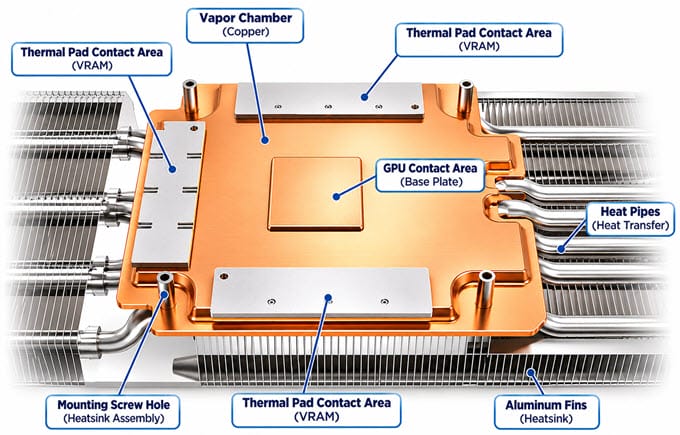
A hybrid vapor chamber combines a vapor chamber with conventional heat pipes in a single cooling assembly. The vapor chamber acts as the main heat-spreading base, while the heat pipes transport heat to different sections of the heatsink. This combination is commonly used in high-end graphics cards because it provides effective heat spreading and heat distribution throughout the heatsink. Most graphics cards use a hybrid vapor chamber design.
3D Vapor Chamber
A 3D vapor chamber features a three-dimensional construction that goes beyond the conventional flat vapor chamber design. Instead of functioning solely as a flat heat spreader, it integrates vertical heat pipes, tubular extensions, or folded fin structures directly into or extending from the vapor chamber cavity. This design allows heat to move directly upward and into densely packed fin stacks, reducing reliance on a conventional one-dimensional conduction path. It helps transfer heat more efficiently from the GPU to the heatsink and improves the overall thermal management of the cooling assembly.
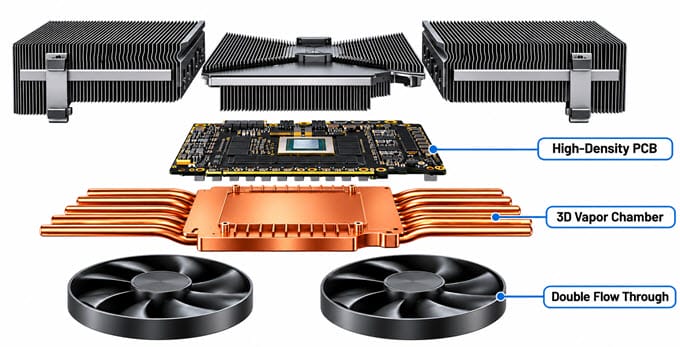
NVIDIA uses a 3D vapor chamber in its GeForce RTX 5090 Founders Edition graphics card. Its design integrates the vapor chamber with heat pipes and the cooling fin structure to improve heat distribution and dissipation within the compact cooler.
Thin and Thick Vapor Chambers
Vapor chambers can also differ in thickness depending on their intended application and cooling requirements. A thin vapor chamber is useful where space is limited, while a thicker chamber can provide additional room for internal structures and working fluid. The internal wick structure and chamber design also play an important role in determining heat-transfer performance.
Vapor Chamber in Graphics Card Cooling
Most graphics cards with vapor chamber cooling use a copper vapor chamber as the base plate of the cooling assembly. The vapor chamber makes direct contact with the GPU and VRAM through thermal interface materials. It absorbs heat from these components and spreads it across its surface. The heat is then transferred to the main heatsink, which usually consists of aluminum fins and copper heat pipes. The cooling fans push air through the heatsink to dissipate the heat into the surroundings.
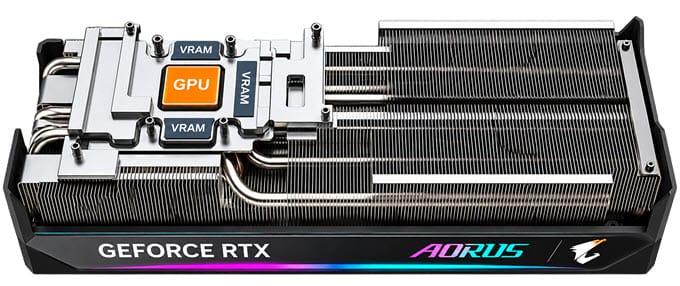
Some graphics cards use a vapor chamber that covers only the GPU, while others extend its coverage to the memory chips and other components. Blower-style graphics cards can also use an extended vapor chamber design. These coolers generally have a more compact heatsink and use a blower fan to exhaust hot air outside the PC case. The extended chamber can cover the GPU, memory, and VRM areas, depending on the design.
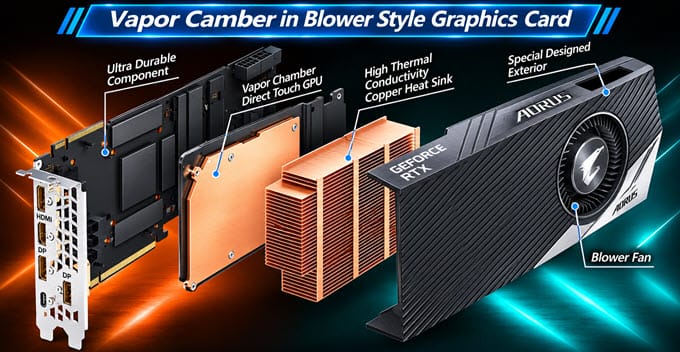
It is important to note that the presence of a vapor chamber does not necessarily mean that a graphics card will run cooler than every model using conventional heat pipes. The overall cooling performance also depends on the heatsink size, fin density, heat pipe arrangement, fan configuration, and power limit.
NVIDIA Graphics Cards with Vapor Chamber
NVIDIA and its board partners have used vapor chamber cooling in several generations of GeForce graphics cards. It is particularly common in high-end models and certain blower-style designs.
NVIDIA Founders Edition Graphics Cards
NVIDIA has incorporated vapor chamber cooling in its Founders Edition graphics cards across different generations. The GeForce RTX 30 Series Founders Edition cards use a hybrid vapor chamber cooling solution. NVIDIA designed the cooler with a dual-axial fan arrangement, where one fan draws air through the heatsink, and another helps exhaust hot air through the rear and top of the card. The GeForce RTX 5090 Founders Edition uses a more advanced 3D vapor chamber design integrated with heat pipes and active fins. This design helps distribute heat more efficiently while maintaining a compact dual-slot form factor.
ASUS
ASUS uses vapor chamber cooling in selected high-end ROG graphics cards. The ROG Astral GeForce RTX 5090 and RTX 5080 feature a patented vapor chamber with milled pathways that allow the heat pipes to integrate into the chamber without flattening. This arrangement increases the contact area and improves heat transfer. The ROG Astral RTX 5090 also features a four-fan cooling design.
MSI
MSI uses its Advanced Vapor Chamber technology in selected high-end graphics cards. The GeForce RTX 5090 SUPRIM SOC and VANGUARD SOC Launch Edition feature a vapor chamber that absorbs heat from the GPU and VRAM and transfers it to the core pipes.
Gigabyte
Gigabyte uses large vapor chambers in selected AORUS and GAMING graphics cards. The vapor chamber makes direct contact with the GPU and works alongside composite copper heat pipes to transfer heat to the heatsink.
Palit and Gainward
Palit uses vapor chamber cooling in selected GameRock graphics cards. Its vapor chamber is designed to cover the GPU and VRAM, spreading heat evenly across the contact surface.
Gainward also uses vapor chambers in selected Phoenix and Phantom series graphics cards. Its chamber helps distribute heat across the GPU’s hot spots before transferring it to the heat pipes.
GALAX and INNO3D
GALAX has used vapor chamber cooling in selected GeForce RTX 20 Series graphics cards, including the RTX 2080 Ti blower and custom models.
INNO3D has also incorporated a jumbo vapor chamber in selected graphics cards, including the GeForce RTX 2070 X2 OC.
Nvidia Graphics Cards with Vapor Chamber
Here are some popular Nvidia graphics cards that use a vapor chamber in their cooling design.
| Graphics Card | Fans | Slots | Vapor Chamber |
| ASUS ROG Astral GeForce RTX 5090 | 4 | 3.8-slot | Patented vapor chamber in the cooling assembly |
| ASUS ROG Astral GeForce RTX 5080 | 4 | 3.8-slot | Patented vapor design |
| ASUS TUF Gaming GeForce RTX 5090 | 3 | 3.6-slot | Vapor chamber combined with 12 heat pipes |
| ASUS ProArt GeForce RTX 5090 | 2 | 2.5-slot | Custom vapor chamber |
| ASUS ProArt GeForce RTX 5080 | 3 | 2.5-slot | Custom vapor chamber |
| ASUS ROG Matrix GeForce RTX 5090 30th Anniversary Edition | 3 | 3.9-slot | Patented vapor chamber |
| Gigabyte AORUS GeForce RTX 5090 MASTER 32G | 3 | 3.75-slot | Large vapor chamber |
| Gigabyte AORUS GeForce RTX 5090 INFINITY | 2 | 3.9-slot | Superconducting heat pipes and a direct-touch vapor chamber |
| Gigabyte AORUS GeForce RTX 5080 MASTER | 3 | 3.75-slot | Large vapor chamber |
| Gigabyte GeForce RTX 4090 WINDFORCE 24G | 3 | 3.5 | Vapor chamber with heat pipes |
| GALAX GeForce RTX 5080 HOF Extreme | 4 (3 front + 1 rear) | 4-slot | Vapor chamber combined with 8 heat pipes. |
| GALAX GeForce RTX 5080 HOF Gaming White | 3 | 3-slot | Wide-coverage nickel-plated vapor chamber and composite heat pipes. |
| Gainward GeForce RTX 5070 Ti Phoenix GS | 3 | 3-slot | Vapor Chamber with antioxidant capacity |
| INNO3D GeForce RTX 5090 X3 OC | 3 | 3-slot | Large vapor chamber provides full coverage for the GPU and memory. |
| INNO3D GeForce RTX 5060 Ti PRO Single Slot | 1 blower | 1-slot | Extended Vapor chamber |
| MSI GeForce RTX 5090 32G SUPRIM SOC | 3 | 3.8-slot | Advanced vapor chamber transfers heat from the GPU and VRAM to the core heat pipes. |
| MSI GeForce RTX 5090 SUPRIM OC | 3 | 3.75-slot | Advanced Vapor Chamber |
| MSI GeForce RTX 5080 SUPRIM SOC | 3 | 3.75-slot | Advanced Vapor Chamber |
| MSI GeForce RTX 5080 SUPRIM DRACO EPIC | 3 | 3.75-slot | Advanced Vapor Chamber |
| MSI GeForce RTX 4080 SUPER SUPRIM X | 3 | 3-slots | Large Vapor Chamber |
| NVIDIA GeForce RTX 5090 Founders Edition | 2 | 2-slot | 3D vapor chamber integrated with heat pipes and active fins. |
| NVIDIA GeForce RTX 4090 Founders Edition | 2 | 3-slot | Vapor-chamber cooling listed in earlier Founders Edition research; exact design details need verification. |
| NVIDIA GeForce RTX 4080 Founders Edition | 2 | 3-slot | Large Vapor-chamber. |
| NVIDIA GeForce RTX 3090 Ti Founders Edition | 2 | 3-slot | Hybrid vapor-chamber cooling |
| NVIDIA GeForce RTX 3090 Founders Edition | 2 | 3-slot | Hybrid vapor chamber with dual-axial flow-through cooling. |
| NVIDIA GeForce RTX 3080 Ti Founders Edition | 2 | 2-slot | Hybrid vapor-chamber |
| NVIDIA GeForce RTX 3080 Founders Edition | 2 | 2-slot | Hybrid vapor-chamber |
| NVIDIA GeForce RTX 2080 Ti Founders Edition | 2 | 2-slot | Full-sized vapor chamber with two fans. |
| NVIDIA GeForce RTX 2080 Founders Edition | 2 | 2-slot | Full-length vapor chamber |
| NVIDIA GeForce RTX 2070 Founders Edition | 2 | 2-slot | Vapor-chamber dual-axis cooling |
| Palit GeForce RTX 5090 GameRock OC | 3 | 3.5-slot | High-performance vapor chamber combined with composite heat pipes. |
| Palit GeForce RTX 5090 GameRock | 3 | 3.5-slot | High-performance vapor chamber combined with composite heat pipes. |
| Palit GeForce RTX 5080 GameRock OC | 3 | 3.5-slot | Vapor chamber for GPU and VRAM |
| PNY GeForce RTX 5080 Slim | 2 | 2-slot | Custom vapor chamber baseplate for GPU and VRAM |
| PNY GeForce RTX 5070 Ti Slim | 2 | 2-slot | Custom vapor chamber baseplate for GPU and VRAM |
| PNY GeForce RTX 5070 Slim | 2 | 2-slot | Custom vapor chamber baseplate for GPU and VRAM |
| Palit GeForce RTX 4090 GameRock | 3 | 3.5-slot | Vapor chamber |
| Gainward GeForce RTX 5080 Phoenix GS | 3 | 3-slot | Vapor chamber |
| Gainward GeForce RTX 4090 Phantom GS | 3 | 3.5 | Vapor chamber |
| Palit GeForce RTX 4090 GameRock | 3 | 3.5-slot | Vapor chamber |
AMD Graphics Cards with Vapor Chamber
AMD graphics cards with vapor chamber cooling are available from several board partners. Sapphire is particularly well known for its Vapor-X cooling technology, which has been used in multiple Radeon graphics card generations. Other manufacturers, including XFX, PowerColor, and ASRock, have also used vapor chamber cooling in selected Radeon models.
Sapphire
Sapphire is one of the most prominent manufacturers to use vapor chamber cooling in Radeon graphics cards. Its Vapor-X technology has been used in several generations of high-performance Radeon graphics cards.
The NITRO+ Radeon RX 7900 XTX Vapor-X and RX 7900 XT Vapor-X are two notable examples. Their vapor chambers make direct contact with the GPU and GDDR6 memory and work alongside optimized composite heat pipes, heatsink fins, and cooling fans.
Sapphire’s earlier NITRO+ Radeon RX 6000 Series graphics cards also feature vapor chamber cooling in selected models.
Other AMD Graphics Card Manufacturers
XFX, PowerColor, and ASRock have also incorporated vapor chamber cooling in selected Radeon graphics cards. Their cooling assemblies vary by model and generation. When identifying these models, it is important to check the individual product specifications rather than assuming that all cards in a particular series feature a vapor chamber.
AMD Graphics Cards with Vapor Chamber
Here are some popular AMD graphics cards that use a vapor chamber in their cooling design.
| Graphics Card | Fans | Slots | Vapor Chamber |
| ASRock Radeon RX 7900 XTX Creator 24GB | 1 blower | 2-slot | Vapor-chamber heatsink spreads heat to the aluminum fin stack |
| ASRock Radeon RX 7900 XT Creator 20GB | 1 blower | 2-slot | Vapor-chamber heatsink spreads heat to the aluminum fin stack |
| ASRock Radeon AI PRO R9700S Passive 32GB | 0 (passive) | 2-slot | Passive vapor-chamber cooling |
| PowerColor Radeon AI PRO R9700 32GB | 1 blower | 2-slot | Vapor chamber transfers heat from the GPU die across the full base into the aluminum fin stack. |
| Gigabyte AORUS Radeon RX 9070 XT ELITE | 3 | 3.75-slot | Large Vapor Chamber |
| Gigabyte Radeon RX 9070 XT GAMING OC | 3 | 3.75-slot | Large Vapor Chamber |
| Sapphire NITRO+ Radeon RX 7900 XTX Vapor-X 24GB | 3 | 3.5-slot | Vapor chamber contacts the GPU and GDDR6 memory |
| Sapphire NITRO+ Radeon RX 7900 XT Vapor-X 20GB | 3 | 3.5-slot | Vapor chamber contacts the GPU and GDDR6 memory |
| Sapphire NITRO+ Radeon RX 6950 XT | 3 | 2.7-slot | Vapor-X vapor chamber |
| Sapphire NITRO+ Radeon RX 6950 XT PURE | 3 | 3.5-slot | Vapor-X vapor chamber |
| Sapphire NITRO+ Radeon RX 6900 XT SE | 3 | 2.7-slot | Vapor-X vapor chamber |
| Sapphire NITRO+ Radeon RX 6800 XT SE | 3 | 2.7-slot | Vapor-X vapor chamber |
| Sapphire NITRO+ Radeon RX 6800 | 3 | 2.7-slot | Vapor-X vapor chamber |
| Sapphire NITRO+ Radeon RX Vega 64 8GB HBM2 Limited Edition | 3 | 3-slot | Vapor Chamber for GPU and HBM2 memory |
| Sapphire NITRO+ Radeon RX Vega 56 8GB HBM2 Limited Edition | 3 | 3-slot | Vapor Chamber for GPU and HBM2 memory |
| Sapphire NITRO+ Radeon RX Vega 56 LE | 3 | 3-slot | Vapor Chamber for GPU and HBM2 memory |
| Sapphire Radeon RX 5700 XT 8GB GDDR6 (blower) | 1 blower | 2-slot | Vapor-chamber cooling with graphite thermal interface |
| XFX Mercury Radeon RX 9070 XT OC Gaming Edition with RGB | 3 | 3.5-slot | Vapor chamber and PTM7950 Thermal Pad |
| XFX Mercury Radeon RX 7900 XTX Magnetic Air | 3 | 3.5-slot | Vapor chamber for GPU and VRAM |
| XFX Speedster MERC 310 Radeon RX 7900 XTX Black Edition | 3 | 2.9-slot | Vapor-chamber for GPU and VRAM |
| XFX Speedster MERC 310 Radeon RX 7900 XT | 3 | 2.7-slot | Vapor-chamber for GPU and VRAM |
Final Words
Vapor chamber cooling is not necessary for every graphics card. Entry-level and mid-range graphics cards generally produce less heat and can be cooled effectively using conventional heatsinks and heat pipes. However, high-end graphics cards with higher power consumption and thermal output can benefit significantly from vapor chamber cooling. It helps distribute heat more evenly across the cooler and reduces concentrated hot spots around the GPU. A vapor chamber also does not guarantee better cooling performance. The overall cooler design, heatsink size, heat pipes, fan arrangement, and thermal interface materials all contribute to the final thermal performance. Therefore, when choosing a graphics card, it is worth considering the complete cooling solution rather than looking at the vapor chamber feature alone.
(*This post may contain affiliate links, which means I may receive a small commission if you choose to purchase through the links I provide (at no extra cost to you). Thank you for supporting the work I put into this site!)