Since the launch of NVIDIA’s GeForce RTX 40 series, the 12VHPWR (16-pin) power connector has become one of the most debated topics in the PC hardware community. Although it was introduced to simplify power delivery for high-end graphics cards, numerous reports of melting connectors and damaged cables quickly raised concerns among enthusiasts and system builders. While the updated 12V-2×6 connector has significantly improved the design and addressed many of the original issues, melting issues are still being reported. Also, some users still prefer graphics cards that use the tried-and-tested 8-pin PCIe power connectors.
Traditional PCIe power connectors have been around for years and have proven to be reliable under heavy workloads. They are also compatible with older power supplies, eliminating the need for adapters or ATX 3.x power supplies. For users upgrading an existing PC or building a new system with a high-quality ATX 2.x PSU, choosing a graphics card with standard 8-pin connectors can simplify installation and provide added peace of mind. The good news is that there are still excellent graphics cards from both AMD and NVIDIA that use conventional PCIe power connectors. These cards offer outstanding gaming performance, content creation capabilities, and excellent value without requiring the newer 16-pin power interface. In this guide, I have selected the best graphics cards without a 12VHPWR or 12V-2×6 connector, ranging from flagship AMD models to capable mid-range NVIDIA offerings.
Best AMD Graphics Cards without 16-pin Power Connector
AMD currently offers the most powerful graphics cards that continue to rely on traditional PCIe power connectors. Unlike NVIDIA’s latest high-end GeForce lineup, several Radeon RX 9000 and RX 7000 series models still use dual or triple 8-pin PCIe connectors, making them an excellent choice for users who wish to avoid the newer 16-pin standard. Below are the best AMD graphics cards without a 12VHPWR or 12V-2×6 connector.
Radeon RX 9070 XT
[The Best Graphics Card without a 12VHPWR Connector]
The AMD Radeon RX 9070 XT is currently the most powerful graphics card available that primarily uses traditional dual 8-pin PCIe power connectors. Based on AMD’s latest RDNA 4 architecture, it delivers flagship-class gaming performance while avoiding the 16-pin power connector used on competing high-end NVIDIA cards. Performance-wise, the RX 9070 XT competes closely with the GeForce RTX 5070 Ti in modern games. It offers excellent rasterization performance at both 1440p and 4K resolutions, while also delivering substantial improvements in ray tracing compared to previous Radeon generations. AMD has also enhanced AI acceleration, making the card more capable for AI-assisted workloads, image generation, and content creation applications.
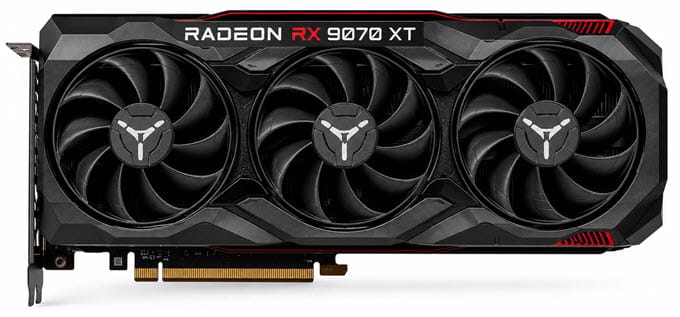
One of the biggest advantages of the RX 9070 XT is its power connector configuration. Most custom models continue to use two standard 8-pin PCIe connectors, allowing users to pair the card with existing high-quality ATX 2.x power supplies. However, a few premium factory-overclocked models, such as the Sapphire NITRO+ Radeon RX 9070 XT and ASRock Radeon RX 9070 XT Taichi, use the newer 12V-2×6 connector. If avoiding the 16-pin connector is your priority, verify the connector configuration before purchasing. For gamers, the RX 9070 XT is an outstanding choice for high-refresh-rate 1440p gaming and smooth 4K gameplay. Its 16GB of GDDR6 memory also provides ample headroom for modern AAA titles, texture-heavy games, and professional applications.
Check out: Best RX 9070 XT Models for 1440p and 4K Gaming
Note: Some custom RX 9070 models may use three 8-pin PCIe connectors.
Top Recommended Radeon RX 9070 XT Models
| Model | Fans | Slot Width | Features | Power Connectors |
| Sapphire PULSE Radeon RX 9070 XT | 3 | 3-slot | Excellent value, quiet cooler | 2 × 8-pin |
| PowerColor Hellhound RX 9070 XT | 3 | 2.5-slot | Low noise, efficient cooling | 2 × 8-pin |
| XFX Mercury RX 9070 XT OC Magnetic Air Edition | 3 | 3-slot | High factory overclock, ARGB Lighting, Easy Fan Swap and Removal | 3 × 8-pin |
| ASUS TUF Gaming RX 9070 XT OC Edition | 3 | 3-slot | Premium build quality, Powerful Cooler, Feature Rich, ARGB Lighting | 3 × 8-pin |
Why Buy the Radeon RX 9070 XT?
- Fastest graphics card with traditional PCIe power connectors.
- Excellent 1440p and 4K gaming performance.
- 16GB VRAM for modern AAA games and content creation.
- Compatible with most quality ATX 2.x power supplies.
- Outstanding choice for users avoiding 12VHPWR.
Radeon RX 7900 XTX
[The Best 24GB Graphics Card without a 12VHPWR Connector]
If you need massive VRAM and excellent 4K gaming performance without using a 12VHPWR or 12V-2×6 connector, the AMD Radeon RX 7900 XTX remains one of the best choices available. Although it is based on AMD’s previous-generation RDNA 3 architecture, it still delivers flagship-level gaming performance and remains highly competitive against many newer graphics cards. The RX 7900 XTX features 24GB of GDDR6 memory connected through a wide 384-bit memory bus, providing an impressive 960 GB/s memory bandwidth. This generous memory configuration makes it an excellent option not only for 4K gaming but also for AI workloads, 3D rendering, video editing, game development, and other memory-intensive professional applications.
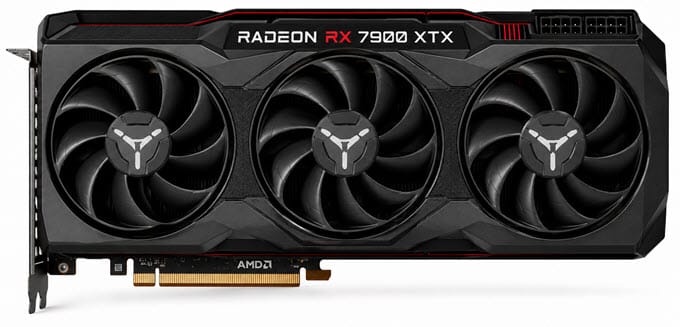
In terms of gaming performance, the RX 7900 XTX is only slightly behind the newer Radeon RX 9070 XT in most modern titles. It excels in traditional rasterization performance and comfortably handles high refresh rate gaming at 1440p as well as demanding 4K gaming. AMD has also improved ray tracing performance through driver optimizations, although NVIDIA still maintains an advantage in ray-traced games. One of the biggest advantages of the RX 7900 XTX is that virtually all custom models continue to use standard PCIe power connectors instead of the newer 16-pin connector. Depending on the manufacturer, the card requires either two or three 8-pin PCIe power connectors, making it fully compatible with most quality ATX 2.x power supplies. Because of its large VRAM capacity, the RX 7900 XTX also offers better long-term value for creators and users working with large datasets than many competing cards equipped with less memory.
Top Recommended Radeon RX 7900 XTX Models
| Model | Fans | Slot Width | Features | Power Connectors |
| Sapphire PULSE Radeon RX 7900 XTX | 3 | 2.7-slot | Excellent value and cooling | 3 × 8-pin |
| Sapphire NITRO+ AMD Radeon RX 9070 XT OC | 3 | 3.5-slot | Premium cooling and factory OC, ARGB LEDs | 3 × 8-pin |
| PowerColor Hellhound RX 7900 XTX | 3 | 3-slot | Quiet operation | 2 × 8-pin |
| XFX Speedster MERC 310 RX 7900 XTX | 3 | 3-slot | High boost clocks | 3 × 8-pin |
| ASUS TUF Gaming RX 7900 XTX OC | 3 | 3.63-slot | Premium build and features, Runs cool and quiet, ARGB | 3 × 8-pin |
Why Buy the Radeon RX 7900 XTX?
- Excellent 4K gaming performance.
- Huge 24GB VRAM ideal for creators and AI workloads.
- Uses traditional PCIe power connectors.
- Outstanding rasterization performance.
- Great option for users who want flagship performance without adopting the 12VHPWR standard.
Radeon RX 9070
[The Best Value High-End Graphics Card without a 12VHPWR Connector]
The AMD Radeon RX 9070 offers one of the best price-to-performance ratios among high-end graphics cards that continue to use traditional PCIe power connectors. Built on AMD’s latest RDNA 4 architecture, it delivers impressive gaming performance while maintaining excellent power efficiency. Although positioned below the RX 9070 XT, the RX 9070 remains a very capable graphics card for enthusiasts. RX 9070 is faster than both the GeForce RTX 4070 Ti and RTX 5070 in conventional gaming workloads, making it an attractive option for gamers looking for high-end performance without paying flagship prices.
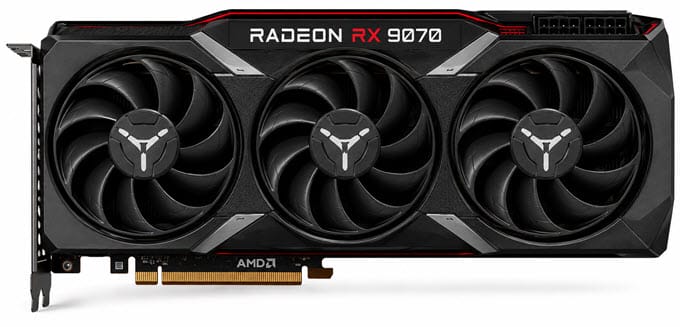
The card comes equipped with 16GB of GDDR6 memory, which is becoming increasingly important for modern AAA games, especially at 1440p Ultra and 4K resolutions. The large VRAM buffer also makes the card suitable for content creators working with large textures, high-resolution video editing, and 3D applications. Power efficiency is another major strength. With a 220W Total Board Power, the RX 9070 consumes significantly less power than many flagship graphics cards while still delivering excellent frame rates. It uses two standard 8-pin PCIe power connectors, allowing users to continue using reliable ATX 2.x power supplies without adapters. Overall, the Radeon RX 9070 strikes an excellent balance between performance, efficiency, memory capacity, and compatibility, making it one of the easiest recommendations for users who specifically want to avoid the newer 16-pin power connector.
Check out: Best RX 9070 Cards [SFF, Premium and Budget Models]
Top Recommended Radeon RX 9070 Models
| Model | Fans | Slot Width | Features | Power Connectors |
| Sapphire PULSE Radeon RX 9070 | 2 | 2.5-slot | Best overall value | 2 × 8-pin |
| PowerColor Hellhound RX 9070 | 3 | 2-slot | Compact and good overall | 2 × 8-pin |
| XFX Swift Radeon RX 9070 OC | 3 | 3.5-slot | High Factory overclock | 2 × 8-pin |
| ASUS Prime Radeon RX 9070 OC | 3 | 2.5-slot | Compact premium design | 2 × 8-pin |
| Gigabyte Radeon RX 9070 GAMING OC 16G | 3 | 2.5-slot | Strong thermal performance, RGB Lighting | 2 × 8-pin |
Why Buy the Radeon RX 9070?
- Excellent price-to-performance ratio.
- Fast enough for high-refresh-rate 1440p gaming and smooth 4K gaming.
- 16GB VRAM offers excellent longevity.
- Lower power consumption than flagship GPUs.
- Uses two reliable 8-pin PCIe power connectors.
- One of the best choices for gamers upgrading from older Radeon RX 6000 or GeForce RTX 30 series graphics cards.
Which AMD Graphics Card Should You Buy?
Choosing the right Radeon GPU depends on your budget and intended use:
- Radeon RX 9070 XT – The best overall choice for users seeking flagship gaming performance without a 12VHPWR connector.
- Radeon RX 7900 XTX – Ideal for 4K gamers, creators, and professionals who benefit from its 24GB of VRAM.
- Radeon RX 9070 – The best value option, offering an excellent balance of performance, efficiency, and affordability while retaining standard 8-pin PCIe power connectors.
Best NVIDIA Graphics Cards without 16-pin Power Connector
Unlike AMD, NVIDIA transitioned to the 12VHPWR connector much earlier for its high-end GeForce RTX 40 series graphics cards. Most models above the GeForce RTX 4070 require either a 12VHPWR or the newer 12V-2×6 connector, making them less appealing to users who prefer conventional 8-pin PCIe power connectors.
Fortunately, NVIDIA still offers a few excellent graphics cards that continue to use the traditional 8-pin PCIe power connector. These GPUs deliver excellent gaming performance, support NVIDIA-exclusive technologies such as DLSS, Frame Generation, CUDA, and NVENC, and remain fully compatible with older ATX 2.x power supplies. Below are the best NVIDIA graphics cards that avoid the 16-pin power connector.
GeForce RTX 4070
[The Fastest NVIDIA Graphics Card with an 8-Pin PCIe Connector]
The GeForce RTX 4070 is the most powerful NVIDIA graphics card that widely uses a standard single 8-pin PCIe power connector, making it the ideal choice for users who want NVIDIA features without moving to the newer 12VHPWR power standard. Built on NVIDIA’s Ada Lovelace architecture, the RTX 4070 delivers exceptional performance for 1440p gaming and can also handle many modern AAA titles at 4K with optimized settings. Its combination of excellent power efficiency and advanced AI-powered technologies makes it one of the most well-rounded graphics cards in NVIDIA’s lineup.
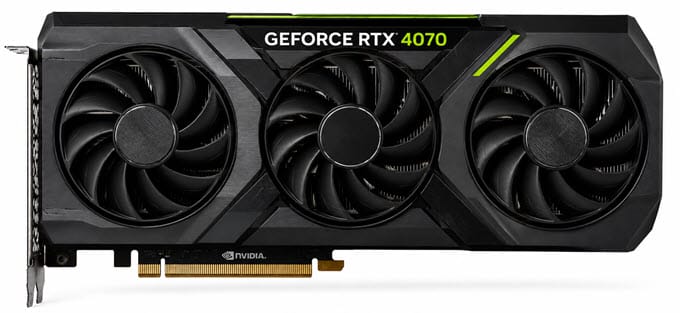
One of the RTX 4070’s biggest strengths is its 200W Total Graphics Power (TGP). Despite consuming significantly less power than previous-generation flagship GPUs, it performs similarly to the GeForce RTX 3080 while generating much less heat and noise. The RTX 4070 also excels in ray tracing performance. NVIDIA’s third-generation RT Cores and fourth-generation Tensor Cores enable advanced ray-traced lighting effects while maintaining high frame rates through DLSS 3 Frame Generation and Super Resolution. These technologies can significantly improve gaming performance in supported titles.
For creators, the RTX 4070 offers excellent support for professional applications because of CUDA acceleration and NVIDIA’s dual 8th-generation NVENC encoders. Video editors, 3D artists, streamers, and AI developers can all benefit from its hardware acceleration. Although newer GeForce RTX 50 series cards have entered the market, the RTX 4070 remains an excellent choice for users who specifically want to avoid the 12VHPWR connector while retaining access to NVIDIA’s mature software ecosystem.
Check out: Best RTX 4070 Custom Models for 1440p & High 4K Gaming
Top Recommended GeForce RTX 4070 Models
| Model | Fans | Slot Width | Features | Power Connectors |
| ASUS Dual GeForce RTX 4070 OC | 2 | 2.5-slot | Compact design, Great Value, and overall performance | 1 × 8-pin |
| MSI Ventus 2X RTX 4070 | 2 | 2.2-slot | Affordable and quiet | 1 × 8-pin |
| Gigabyte GeForce RTX 4070 WINDFORCE OC 12G | 3 | 2.2-slot | Triple-fan cooling, Relatively compact, Good Thermals | 1 × 8-pin |
| Zotac Gaming RTX 4070 Twin Edge OC | 2 | 2.2-slot | Small form factor friendly | 1 × 8-pin |
| ASUS TUF Gaming RTX 4070 OC | 3 | 3-slot | Premium cooling and build quality, ARGB Lighting | 1 × 8-pin |
Why Buy the GeForce RTX 4070?
- Fastest NVIDIA GPU that commonly uses a traditional 8-pin PCIe connector.
- Outstanding 1440p gaming performance.
- Excellent ray tracing performance with DLSS 3.
- Highly power-efficient at only 200W.
- Great choice for gaming, streaming, AI, and professional content creation.
- Compatible with most existing high-quality power supplies.
GeForce RTX 5060 Ti 16GB
[The Best Mid-Range NVIDIA Graphics Card without a 12VHPWR Connector]
For gamers looking for an affordable graphics card that still uses a traditional PCIe power connector, the GeForce RTX 5060 Ti 16GB is one of the most compelling options in NVIDIA’s current lineup. It is a budget mid-range graphics card that is around 13% faster than the RTX 4060 Ti 16GB, while continuing to use a single 8-pin PCIe power connector. Based on NVIDIA’s Blackwell architecture, the RTX 5060 Ti introduces significant improvements in AI processing, ray tracing, and memory technology. One of its standout features is the inclusion of 16GB of high-speed GDDR7 memory, providing a substantial upgrade in memory bandwidth compared to previous-generation mid-range cards.
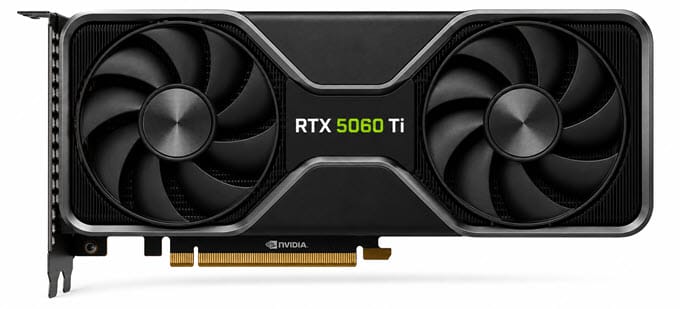
The 16GB VRAM capacity makes the RTX 5060 Ti well-suited for modern AAA games with high-resolution textures, as well as creative workloads such as video editing, photo editing, AI-assisted applications, and entry-level 3D rendering. Another major advantage is its excellent power efficiency. With a 180W Total Graphics Power, the RTX 5060 Ti delivers strong gaming performance while maintaining relatively low temperatures and modest power requirements. Most quality 550W to 650W power supplies can comfortably support this graphics card. For gamers targeting high-refresh-rate 1080p or smooth 1440p gaming, the RTX 5060 Ti offers an excellent balance of performance, features, and efficiency. Combined with NVIDIA’s latest DLSS technologies, it can provide impressive frame rates even in demanding games.
Check out: Best RTX 5060 Ti 16GB Models with 8-pin PCIe Connector
Top Recommended GeForce RTX 5060 Ti 16GB Models
| Model | Fans | Slot Width | Features | Power Connectors |
| ASUS Prime GeForce RTX 5060 Ti 16GB OC | 3 | 2.5-slot | Excellent overall value and performance | 1 × 8-pin |
| MSI Gaming RTX 5060 Ti 16G Shadow 2X OC | 2 | 2.5-slot | Affordable, Factory OC, Compact | 1 × 8-pin |
| Gigabyte RTX 5060 Ti GAMING OC 16G | 3 | 2.2-slot | Triple-fan cooling | 1 × 8-pin |
| ZOTAC GAMING GeForce RTX 5060 Ti 16GB Twin Edge | 2 | 2-slot | Compact design | 1 × 8-pin |
| ASUS TUF Gaming GeForce RTX 5060 Ti 16GB OC | 3 | 3-slot | Premium build quality and features, Excellent Performance | 1 × 8-pin |
Why Buy the GeForce RTX 5060 Ti 16GB?
- Excellent mid-range gaming performance.
- 16GB of fast GDDR7 memory for latest AAA Games.
- Uses a standard 8-pin PCIe power connector.
- Supports the latest DLSS and ray tracing technologies.
- Low 180W power consumption.
- Great choice for gamers upgrading from RTX 3060 Ti, RTX 4060, or older GTX series graphics cards.
Which NVIDIA Graphics Card Should You Buy?
If you’re committed to staying with NVIDIA while avoiding a 12VHPWR or 12V-2×6 connector, the choice is straightforward:
- GeForce RTX 4070 – The best option for enthusiasts seeking the highest gaming performance with a traditional 8-pin PCIe connector.
- GeForce RTX 5060 Ti 16GB – The ideal choice for mainstream gamers who want modern features, generous VRAM, and excellent efficiency without upgrading to a newer power supply.
See also:
- Top Ways to Prevent 12VHPWR / 12V-2×6 Connector Melting
- Top 12V-2×6 Protection Devices to Stop Connector Melting
- Best Budget ATX 3.0 PSUs with 12VHPWR Connector
Final Verdict
If your goal is to avoid the newer 12VHPWR or 12V-2×6 power connector and you don’t want to compromise on performance, then AMD and NVIDIA still offer great options that use reliable 8-pin PCIe power connectors. AMD’s Radeon RX 9070 XT stands out as the best overall choice. If you need the largest VRAM capacity for professional workloads or demanding 4K gaming, the Radeon RX 7900 XTX remains an excellent option with its huge 24GB of memory. For gamers seeking the best value, the Radeon RX 9070 offers an outstanding balance of performance, efficiency, and price, making it one of the strongest recommendations in this category.
On the NVIDIA side, the GeForce RTX 4070 is the fastest widely available GeForce graphics card with a standard 8-pin PCIe connector, while the GeForce RTX 5060 Ti 16GB is an excellent mid-range choice for gamers who want modern features, generous VRAM, and efficient power consumption without adopting the newer 16-pin connector. Ultimately, the best graphics card depends on your budget, gaming resolution, and workload. By carefully verifying the connector configuration of your chosen model, you can enjoy excellent gaming and productivity performance while continuing to use the familiar and dependable 8-pin PCIe power connector. For any queries, please leave a comment below.
(*This post may contain affiliate links, which means I may receive a small commission if you choose to purchase through the links I provide (at no extra cost to you). Thank you for supporting the work I put into this site!)